

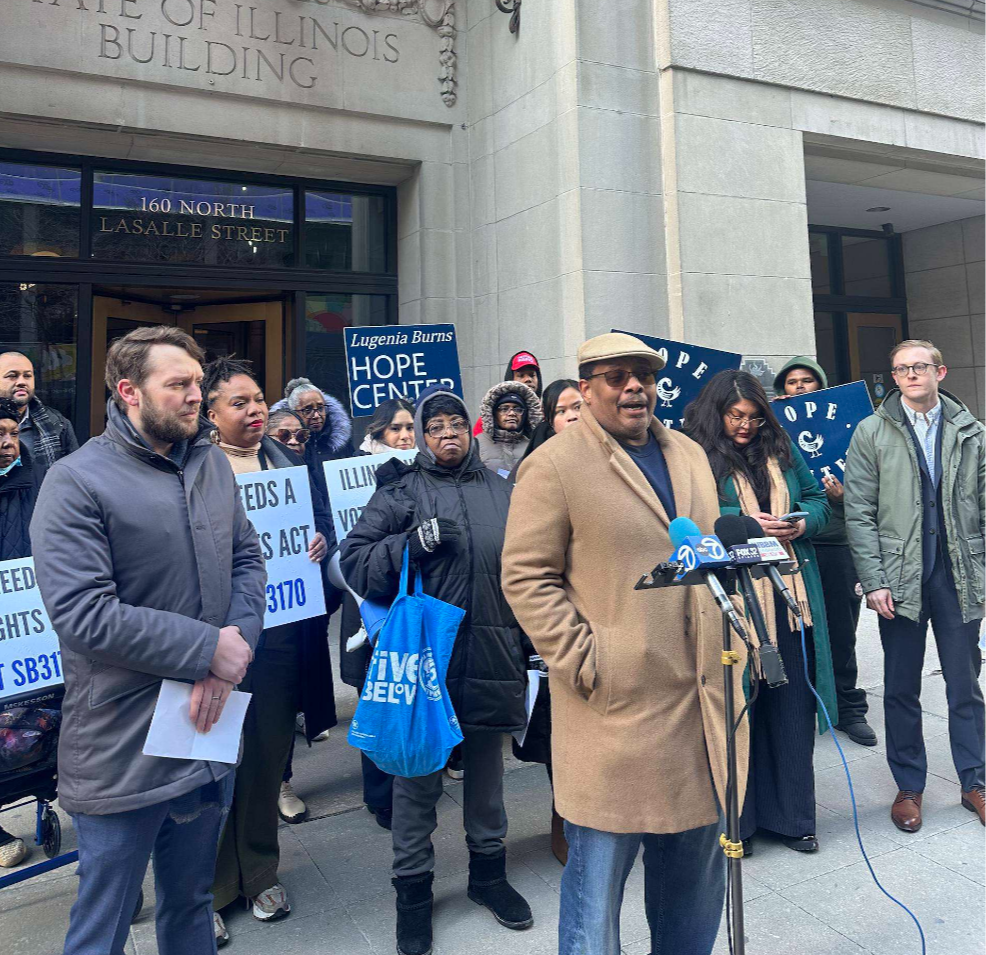
ILLINOIS NEEDS A STRONG, MODERN VOTING RIGHTS ACT
Voting rights are under attack. The current federal administration is doing everything they can to sow distrust in our free and fair elections, hold onto power, and control who has a voice in this country. The protections that were once guaranteed under the federal Voting Rights Act of 1965 are being stripped away.
But advocates across the country are intervening to address these challenges.
Recognizing that Illinois must step up as the federal government steps back, national and state organizations joined forces with voting rights champions to come up with a plan. After a few U.S. Supreme Court decisions weakened federal voting rights protections, advocates soon realized how critical it is to protect voting rights at the state level. After years of seeking input from communities to develop a state Voting Rights Act for Illinois, the Ida B. Wells Voting Rights Act coalition was officially formed in 2026.
ELEMENTS OF THE IDA B. WELLS VOTING RIGHTS ACT
-

Ensure Fair and Accessible Elections
The Ida B. Wells Voting Rights Act will create strict rules against rigged election systems that take away voting power, particularly from Black and Brown communities. You will have a real, fair chance to elect candidates who actually reflect your community's values.
-

Expand Language Access
The Ida B. Wells Voting Rights Act will mandate translated materials and assistance for voters who don’t speak English comfortably so they can cast their ballot with confidence and in their first langauge.
-

Prohibit Voter Suppression
The Ida B. Wells Voting Rights Act will give voters strong legal tools to challenge harmful or unfair voting practices before they become permanent roadblocks.
-

Strengthen Voter Protections
The Ida B. Wells Voting Rights Act will restore protections for Illinois voters that have been eliminated at the federal level.
-
Create Stronger Protections Against Unfair Districts
The Ida B. Wells Voting Rights Act will protect voters of color against district maps or election systems that weaken or silence their voices.
WHY WE NEED THE IL VRA: STORIES FROM ILLINOISANS
NAME; CITY, IL
NAME; CITY, IL
NAME; CITY, IL
RESOURCES
ILVRA Report
Lobby Day Script
Questions? Contact Recie Wilson (recie.wilson@lbhopecenter.com) at Lugenia Burns Hope Center.
WHO WE ARE


SUPPORTERS OF THE IDA B. WELLS VOTING RIGHTS ACT
Frequently Asked Questions
-
The Ida B. Wells Voting Rights Act and the state’s 2011 voting rights law serve entirely distinct purposes and share no functional similarities. The 2011 law strictly dictates how lawmakers must draw legislative and congressional maps.
The Ida B. Wells Voting Rights Act is an anti-discrimination law. It provides communities of color with the legal tools to fight vote dilution and explicitly codifies protections that have been weakened or removed from the federal Voting Rights Act into state law. Because the Ida B. Wells Voting Rights Act focuses on preventing voter discrimination rather than managing the redistricting process, a map-drawing lawsuit, like the one brought earlier this year against the 2011 law, would not apply to it.
-
Federal voting rights protections are increasingly being systematically eliminated through Supreme Court decisions that have gutted key parts of the federal Voting Rights Act, including the recent decision in Louisiana v. Callais that eviscerated Section 2. As these safeguards erode, voters are increasingly vulnerable to discrimination and exclusion. With the passage of State Voting Rights Acts, states can provide key protections to their constituents—particularly voters of color—that prevent and guard against discriminatory voting practices and policies.
The Ida B. Wells Voting Rights Act allows Illinois to take responsibility for protecting the right to vote by restoring and strengthening key protections in state law - so voters are not left unprotected.
-
Yes. Callais does not directly apply to or impact vote dilution protections under the Ida B. Wells Voting Rights Act. The Ida B. Wells Voting Rights Act applies exclusively to state and local districts, meaning it operates outside the scope of the Callais decision, which focused specifically on congressional redistricting.
-
No. The Ida B. Wells Voting Rights Act applies to state and local election systems and districts within Illinois, such as legislative, municipal, and county elections. It does not apply to congressional districts. The Ida B. Wells Voting Rights Act fills a critical gap by strengthening protections in the many state and local elections where discriminatory practices can still occur.