

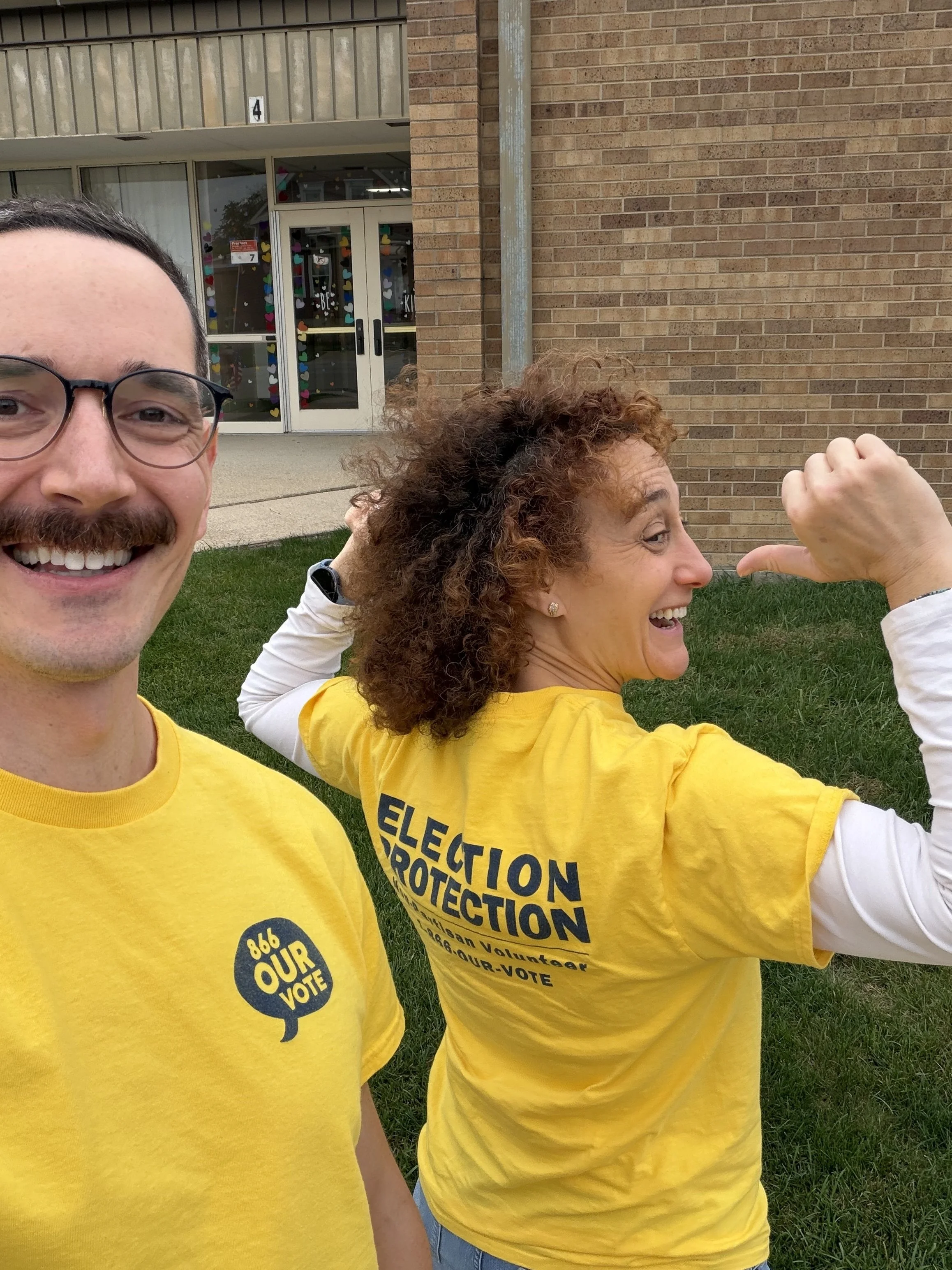
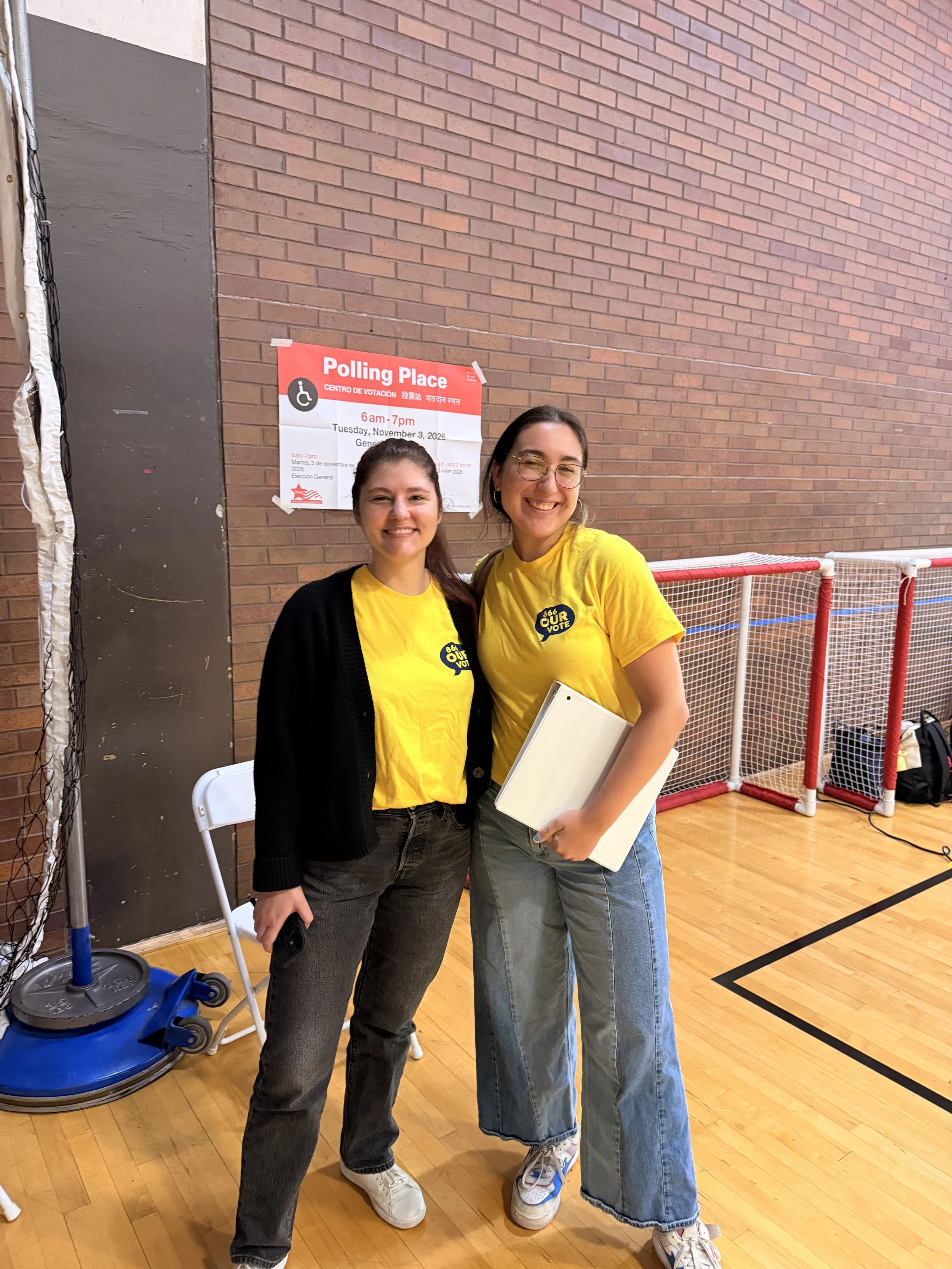
On November 3, despite a tense political environment and fears over federal interference, voters across Illinois and Indiana stepped up and showed up to the polls to vote in the midterm general elections. Chicago Lawyers’ Committee for Civil Rights (CLC) mobilized nonpartisan Election Protection volunteers throughout Illinois and Indiana to support voters in casting their ballots safely and securely. On Election Day, our team deployed field volunteers in the Chicagoland area and select counties across Indiana to assist and advocate for voters at polling locations. Our team also organized volunteer legal professionals to answer voters’ calls to the 866-OUR-VOTE hotline.
During early voting in Illinois, we trained nonpartisan pollwatchers to observe in-person early voting at three county jails, advocating for and assisting voters in pretrial detention at the Cook County Jail, the Will County Adult Detention Facility, and the Lake County Adult Corrections Facility. Our nonpartisan pollwatchers and CLC team members advocated to election officials and jail staff on behalf of voters to resolve issues related to privacy, language access, registration questions, provisional ballots, and access to nonpartisan voter guides.
In the weeks and months before the election, voters faced numerous challenges including disinformation and misinformation, mounting confusion around mail-in voting, and fears about the Trump administration’s threats to deploy federal agents to polling places. CLC, the Illinois Coalition for Immigrant and Refugee Rights (ICIRR), First Defense Legal Aid, and many other partners joined efforts to protect voters’ rights and to serve as a reliable, nonpartisan resource for voters on Election Day (see here for a press release about our Chicago collaborations). Our team also provided numerous trainings and know-your-rights presentations to voters and nonpartisan volunteers in both Illinois and Indiana to ensure they were equipped with knowledge of their legal rights.
On Election Day, Illinois and Indiana voters contacted the 866-OUR-VOTE hotline (and the companion language lines: 888-VE-Y-VOTA for Spanish, 888-API-VOTE for nine Asian languages, and 844-YALLA-US for Arabic) throughout the day with many questions and concerns about different issues, including:
Hours-long lines
Improper requests for identification to enter polling places or cast a ballot
Intrusive or intimidating law enforcement presence at polling locations
Late openings and early closures of polling places
Voter registration challenges, including voters provided wrong information about the requirements for same-day voter registration in Illinois and unhoused voters disenfranchised due to registration challenges
Electioneering
Poll worker misconduct, and
Voter intimidation
Our voting rights team and numerous partners worked together to respond quickly to the challenges voters faced. Our call center was inundated with calls from voters in Chicago who experienced widespread paper ballot shortages and technical issues that led to hours-long lines and late openings of several polling places, creating significant barriers to voting and, in some instances, resulting in voter disenfranchisement entirely. In one particularly acute example, the West Chatham Park polling site was reportedly without paper ballots from 11 a.m. to after 8 p.m., and voters were forced to wait in line for hours to vote on only one electronic voting machine. One of our Election Protection field volunteers stayed on site until the polls closed to support voters and encourage them to stay in line. Common Cause Illinois also delivered pizzas to voters at this location. At locations across the city, after a precinct-based polling site ran out of paper ballots so that voters were limited to only one or a couple of voting machines, voters were redirected to busy vote centers, which are universal polling locations designed to handle more voters than precinct-based polling locations. However, due to the number of voters rerouted to vote centers, some vote centers were also overly crowded with long lines.
Voters also reported that law enforcement presence at some Illinois polling places made them feel concerned or intimidated. For example, in one county, local deputies stopped into several polling locations, reportedly to check on voters and make them feel safe, but their presence sometimes had the opposite effect, as law enforcement presence can be inherently intimidating to some voters. In one instance, our staff were able to work with a local police department to ensure that officers near the polling place did not engage in intimidating behavior or interfere with voters. A nonpartisan pollwatcher was also on site to help voters feel safe.
In Indiana, technical issues caused some voters to experience long lines and wait times. Voters in Hobart and Michigan City, among others, reported broken machines that led to long lines, with some wait times over an hour. These long lines created downstream obstacles for voters trying to cast their ballots across the state. There were some reports of individuals wrongly telling voters they could not vote if they were not inside the polling location by 6 p.m., even though voters are legally entitled to vote so long as they are in line (whether inside or outside of the polling place) by 6 p.m. In response, Indiana community partners, including Common Cause Indiana, the League of Women Voters of Indiana, and Count US Indiana sent field volunteers to the affected polling locations. Equipped with legal knowledge from our voting rights team, legal volunteers, our partners discussed Indiana election law with poll workers and encouraged voters to stay in line so that every voter in line by 6 p.m. could cast a ballot.
Indiana voters also reported many cases of electioneering, including political messaging within the campaign-free zone and lines of people promoting their parties or candidates. Voters also reported feeling intimidated by people collecting signatures for prospective candidates for the next election.
Additionally, CLC received reports of several voter registration issues in Indiana. For example, we received at least two reports of voter registration errors affecting twins and triplets. In at least two counties, voter registration offices mixed up siblings’ records, linking voters to their siblings’ registrations. One voter called our hotline and spent more than an hour working with our Common Cause Indiana partner to get the error corrected, after which the voter successfully cast his ballot. His persistence reflects the commitment so many Hoosiers bring to making sure their voices are heard, and we were proud to help make sure his vote counted.
Indiana voters also faced new concerns about the possibility of federal interference at the polls. Two weeks before Election Day, the United States Department of Justice (DOJ) notified local election officials in Marion and Lake counties that it would deploy election monitors to their polling locations. The announcement alarmed many voters because Marion and Lake counties are home to the largest populations of people of color in Indiana, and people of color are more likely to be targeted by law enforcement. Our Indiana team provided legal guidance to community partners and local election officials on the scope of DOJ’s monitoring authority. We also educated voters on what the monitors could—and more importantly could not—do, and encouraged those with concerns about DOJ’s presence to vote early.
Indiana voters of color also reported discriminatory and intimidating conduct by poll workers. In Fairmont, a voter reported that poll workers spoke favorably of racial hate groups while checking in voters. In Mishawaka, a voter reported a poll monitor looked over the shoulders of voters of color as they cast their ballots. In Indianapolis, a voter was singled out at check-in and asked whether he was a U.S. citizen; after he confirmed that he was, he was told to sit aside for further review. We contacted the election board in each county where misconduct was reported, urging them to investigate these incidents and consider whether the poll workers involved should serve in future elections. We also offered to help review poll worker guidelines to create a more welcoming and equitable Election Day for all voters. Voters have a right to cast their ballots freely and without intimidation.
It has been a challenging season for voting rights and democracy defenders, but CLC and our partners in both Illinois and Indiana worked around the clock during this election cycle to ensure voters could exercise their right to vote free from undue barriers. Thank you to our nearly 200 field and hotline volunteers who saw the urgency of this moment and helped protect the right to vote on Election Day.
CLC would also like to extend our gratitude to the many partners who made our Election Day advocacy possible. Election Protection is truly a people-powered initiative, and we are grateful for our continued collaboration with our partners, including the national Lawyers’ Committee for Civil Rights Under Law, the Illinois Coalition for Immigrant and Refugee Rights, Asian Americans Advancing Justice | Chicago, Chicago Votes, League of Women Voters Illinois, League of Women Voters Indiana, League of Women Voters Chicago, Common Cause Illinois, Common Cause Indiana, Count US Indiana, First Defense Legal Aid, National Lawyers’ Guild Chicago, Equity and Transformation, Workers Center for Racial Justice, the Illinois Alliance for Reentry and Justice, DePaul University Institute for Restorative and Educational Engagement, and many more.
Thanks to your hard work and partnership, we helped support neighbors in making their voices heard this election cycle and encouraged civic participation.